
Slotly: Booking, End to End
A booking system for appointment businesses, designed and built as our own product rather than a one-off site. A customer books from a shared link in about a minute with no account, and the shop runs its day from a console that uses its own trade's words. Slotly
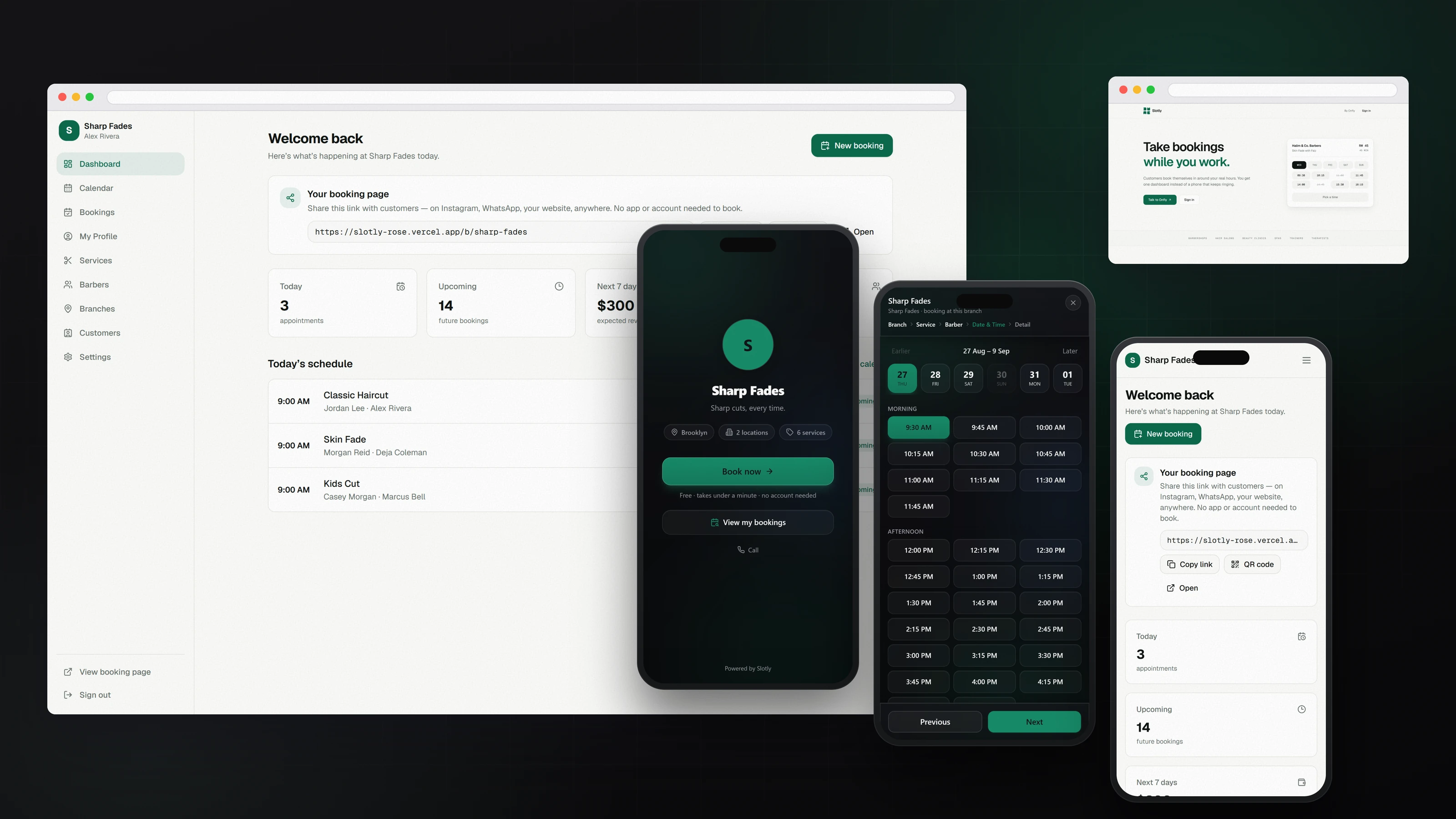
A product, not a booking form
Most small appointment businesses take bookings in three or four places at once, then copy them into a paper diary at the end of the day. The software sold to them assumes a receptionist, a monthly subscription and an afternoon of training, which is why so many shops never switch.
Slotly is the other end of that trade. A shop signs up, picks what it does, and gets a booking page it can paste into an Instagram bio the same afternoon. Behind it sits a back office that asks for nothing it does not need to fill the day, and a database that treats a confirmed appointment as something that cannot be taken twice.
Bookings arrive in a dozen places
Direct messages, phone calls, walk-ins and a comment on a post all land somewhere different. The real diary is whichever one someone remembered to write down.
The double booking nobody catches
Two customers can tap the same time seconds apart. Anything that checks whether a slot is free and then writes it down will eventually let both through.
Every trade names things differently
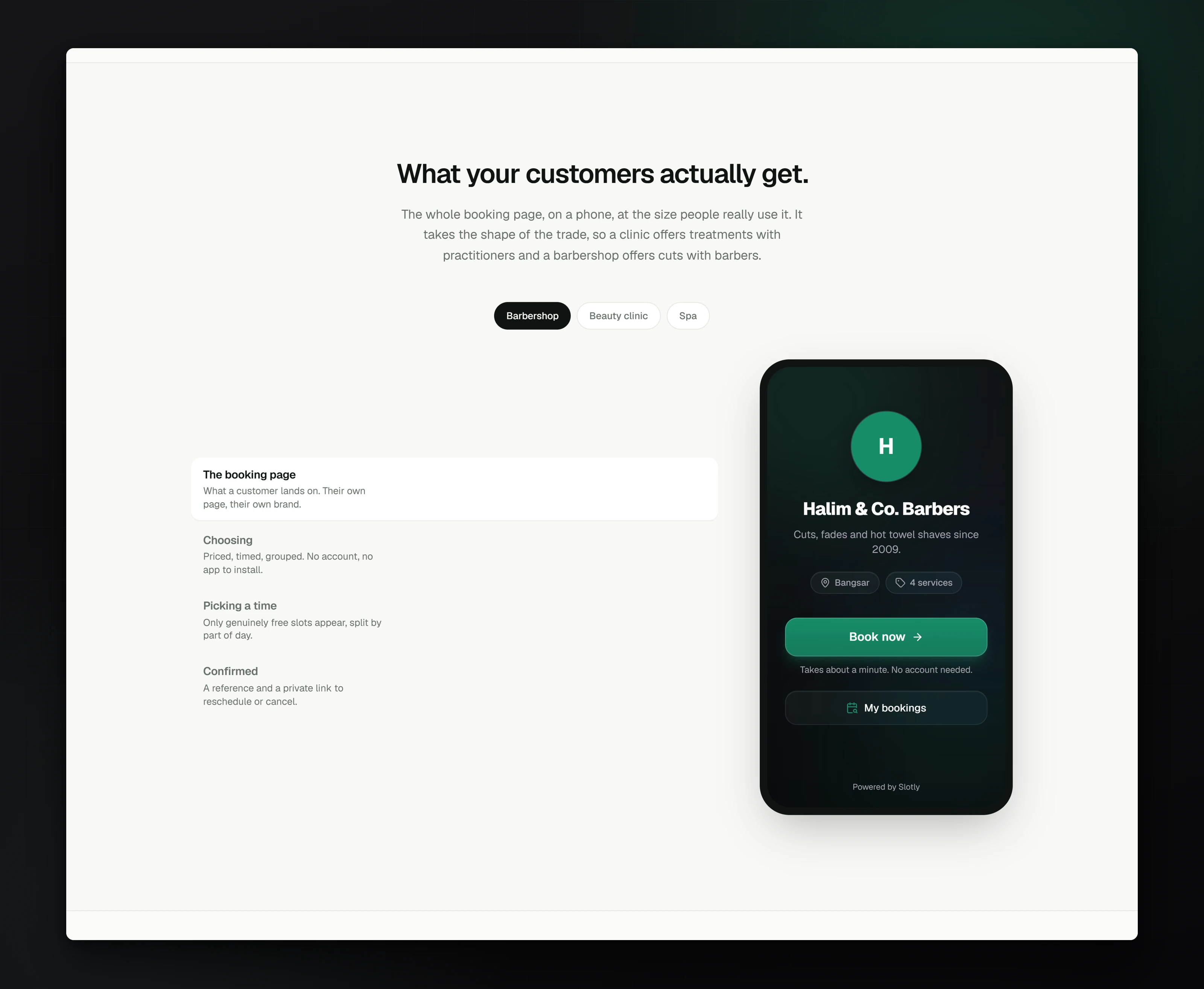
A clinic does not have staff and services. It has practitioners and treatments, and reading its own schedule in someone else's vocabulary slows down every person who touches it.
From a shared link to a confirmed time
A customer arrives from a message or a bio link and never leaves the page. Branch, service, the person they want, a time, then a name and a number. There is no sign-up, no app to install and no password to lose, because every extra field between someone and a booking is a booking that does not happen. The confirmation carries a private link they can use later to move or cancel it themselves.
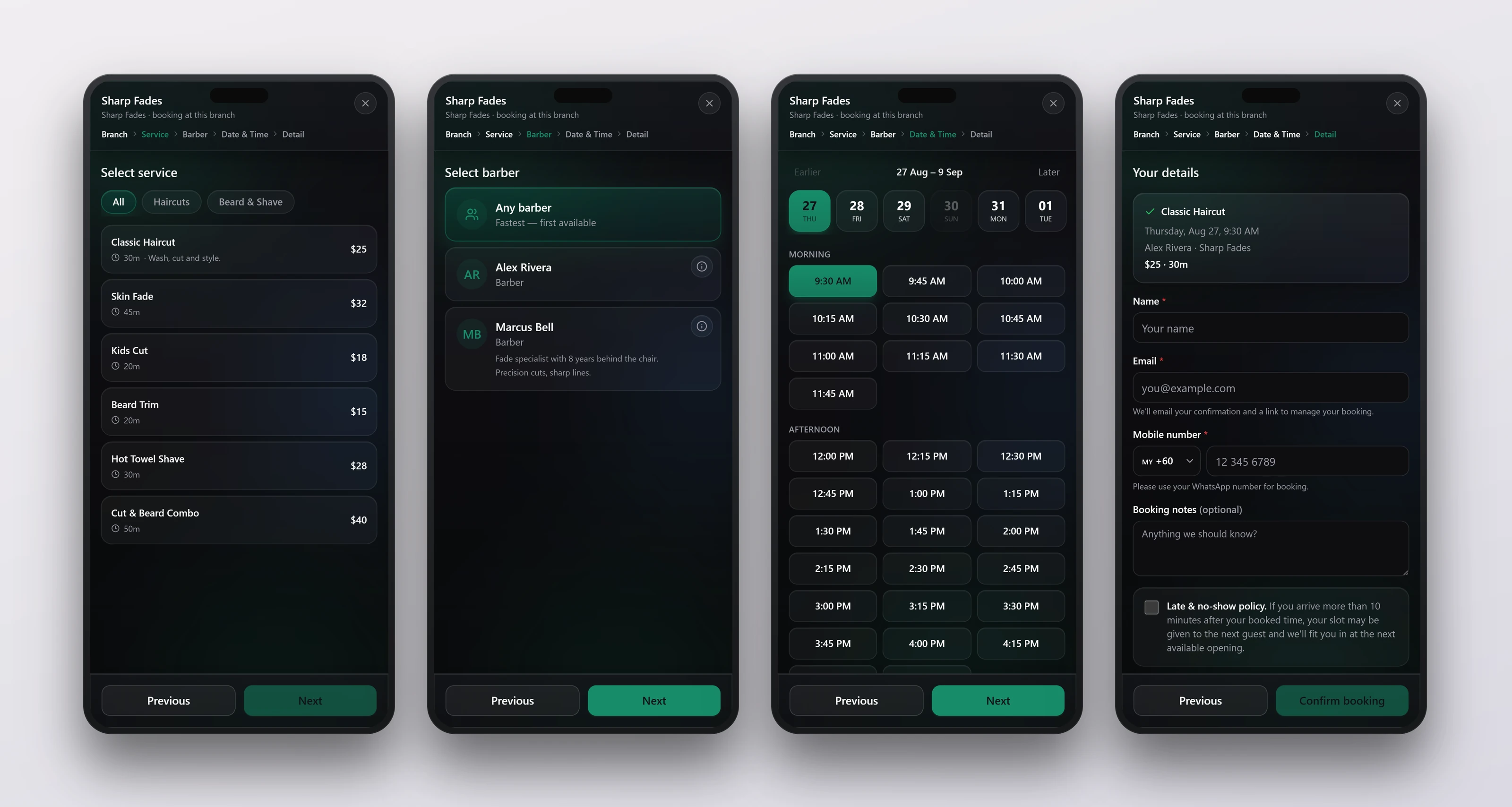
Underneath the booking page
A booking form collects an answer. A booking system has to hold it. That means an appointment that cannot be taken twice, availability worked out the way the shop actually runs, and wording that matches the trade it was bought for.
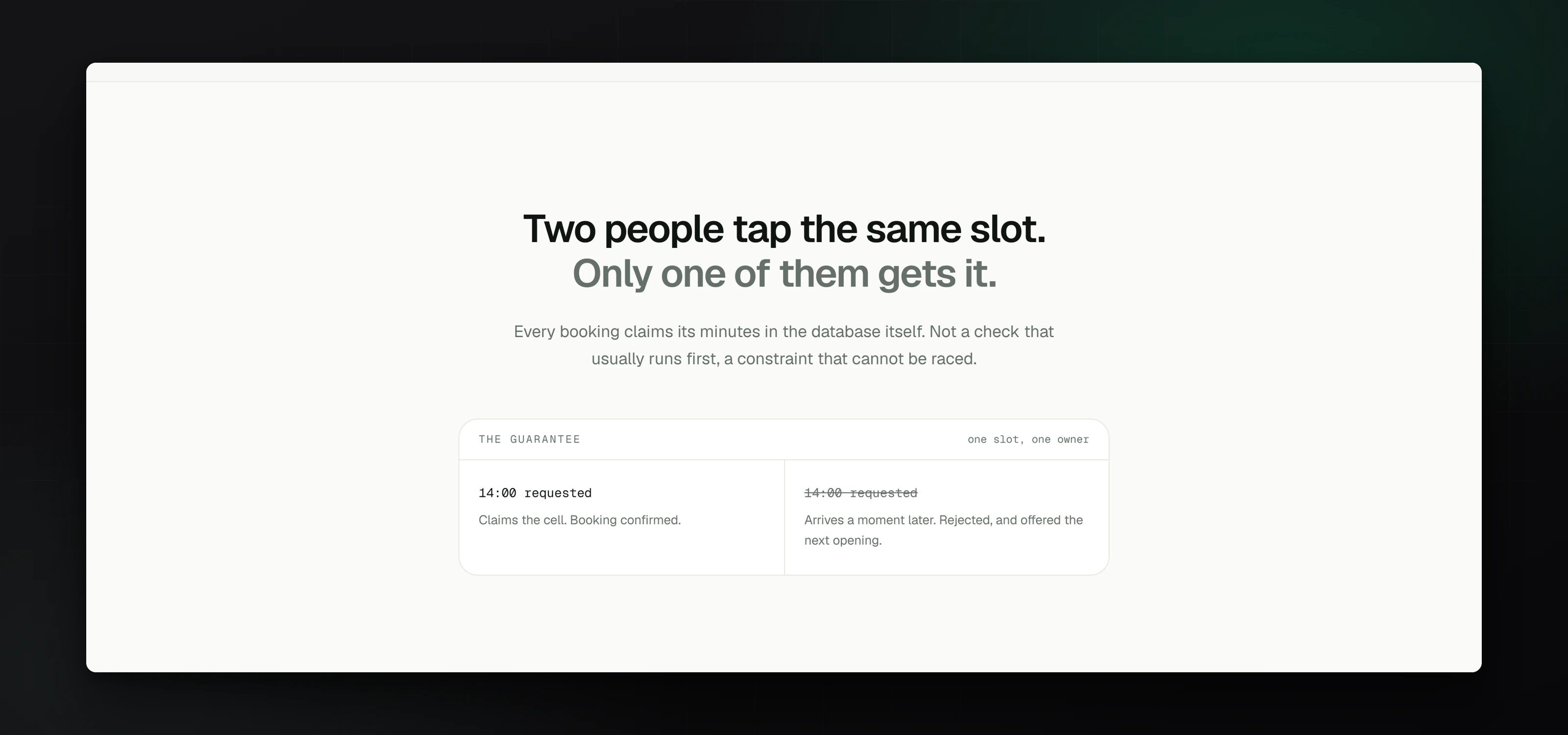
Two people, one slot
Booking is the part of this software that has to be exactly right, so it does not ask whether a time is free and then write it down. Every appointment claims the minutes it occupies as rows the database will only let one booking hold. The second person to tap is turned down in the same instant and offered the next opening, instead of both of them finding out at the chair the next morning.
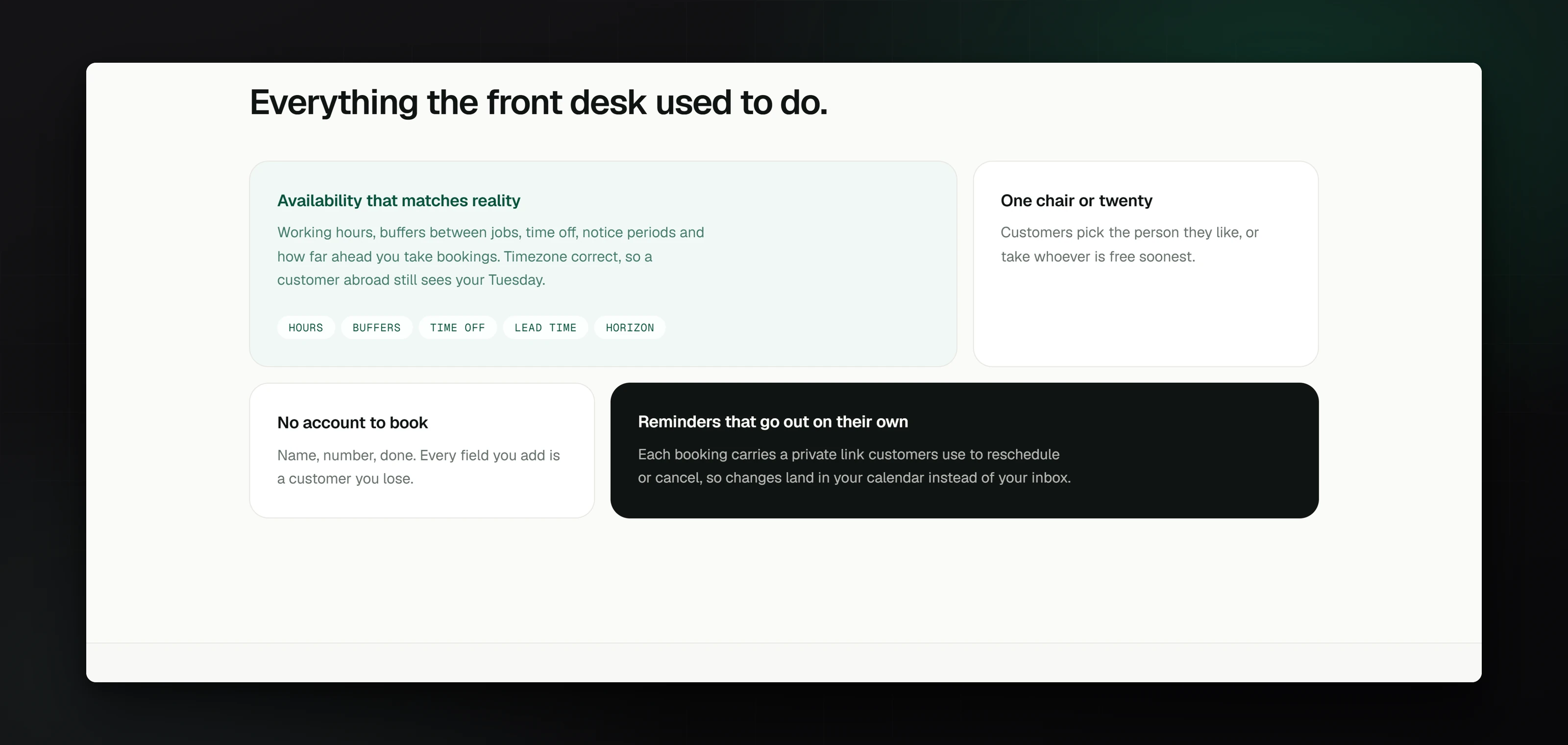
Everything the front desk used to do
Opening hours, buffers between jobs, days off, how much notice is needed and how far ahead the shop takes bookings all feed one availability engine, worked out in the shop's own timezone so a customer booking from abroad still sees the right Tuesday. Confirmations go out on their own, and so do reminders, a day before and again two hours before.
One codebase, ten trades
Barbershops, hair and nail salons, beauty and medical clinics, makeup studios, spas, tattoo artists, gyms and therapists each get their own word for what they sell, for the people who deliver it and for the act of booking. Choosing a trade at sign-up sets that vocabulary, a sensible working week and whether intake forms appear at all. Anything that does not fit the ten falls back to a general default rather than being turned away.
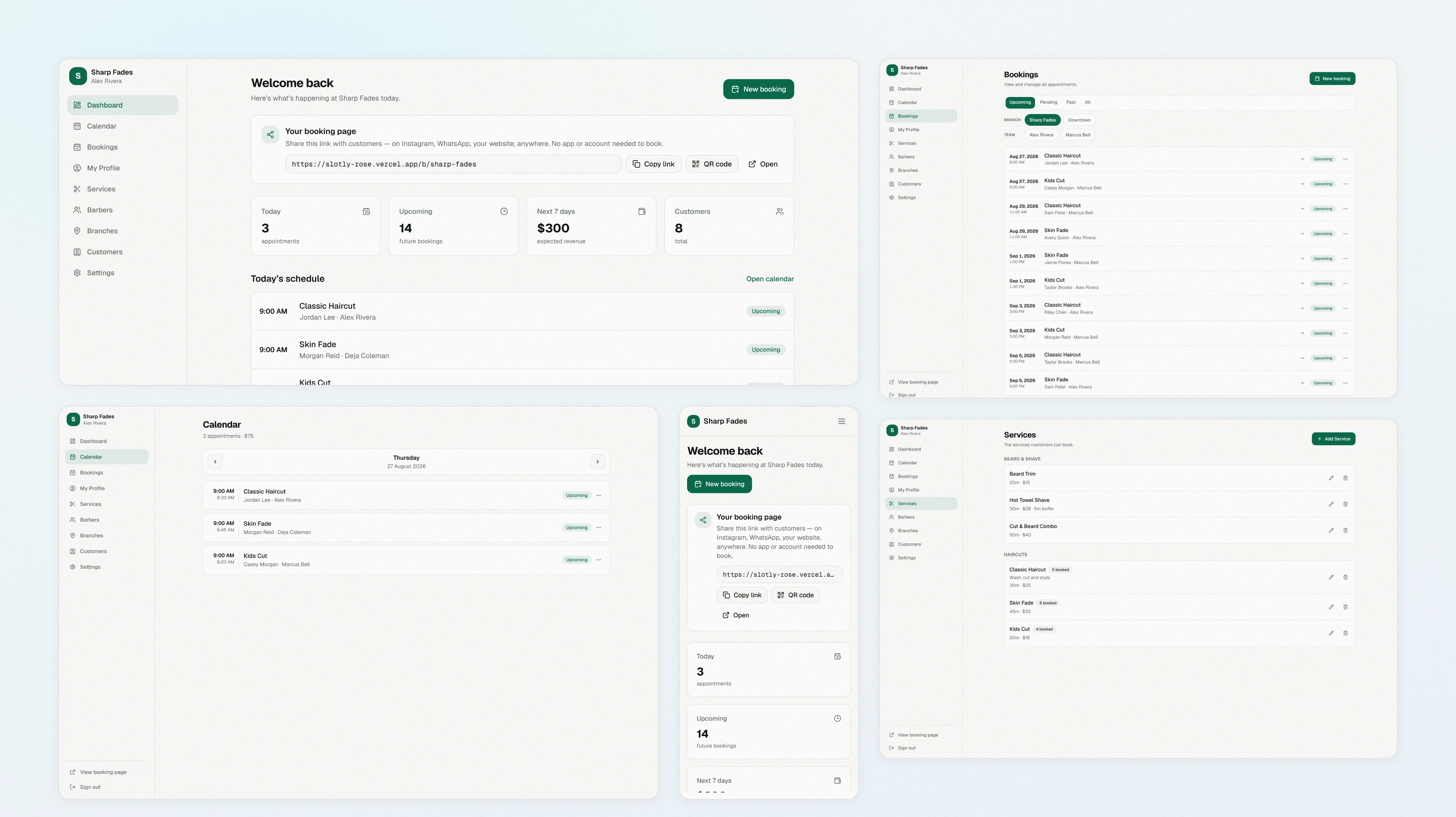
The shop side, nine screens
Today's schedule, a week calendar, the full booking list, services, the team, branches, customers and settings. An owner can add a booking by hand for the walk-in or the phone call that will always exist, and share the booking page as a link or a QR code straight from the dashboard. Someone who only needs their own day is shown their own day and nothing else.
The identity it ships with
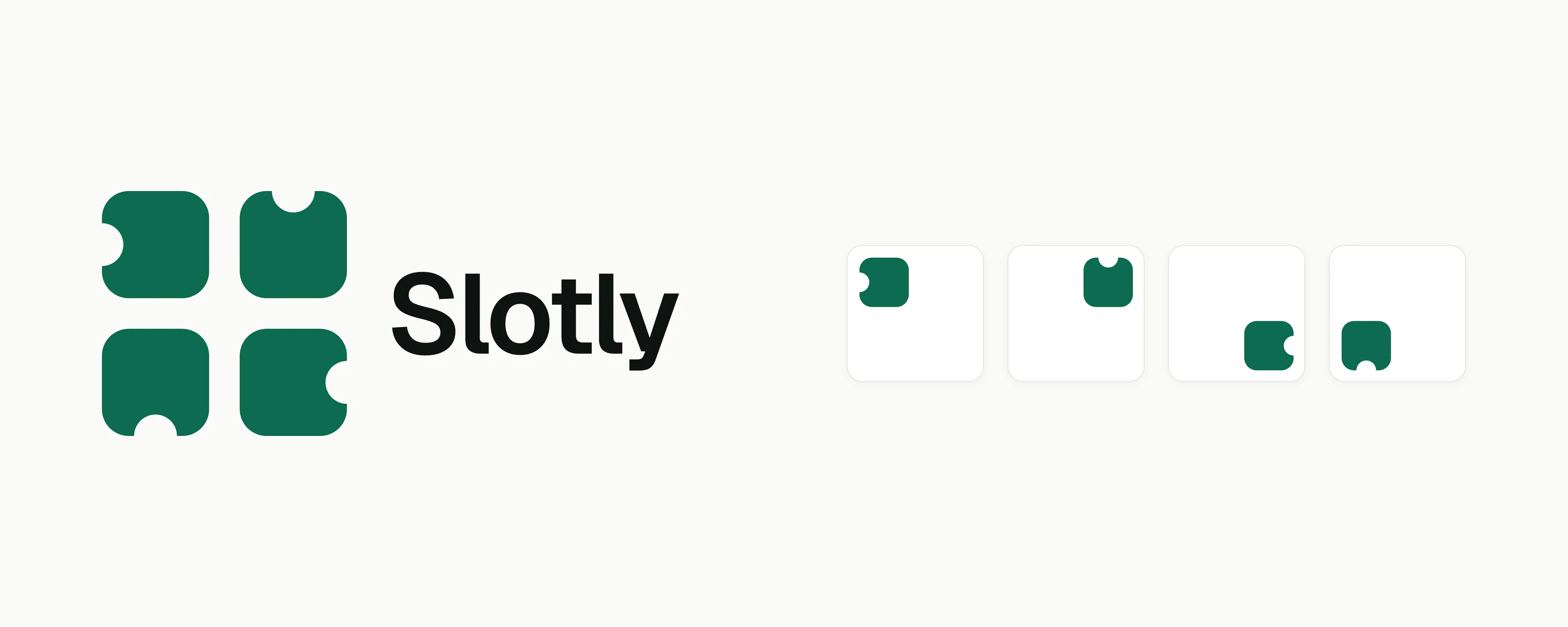
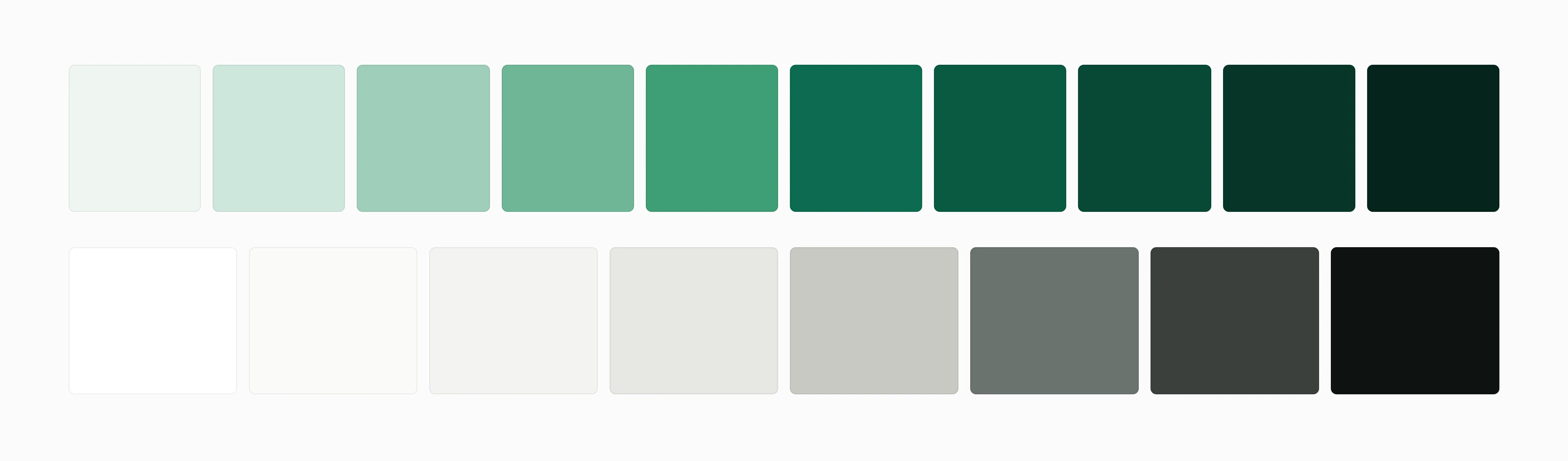
The mark is four blocks of time in a two by two grid, each with a slot bitten out of one edge. One cell is drawn and then placed four times at ninety degree turns, so the whole thing has four fold rotational symmetry: turn it a quarter and it lands back on itself. Geist sets the type. A single evergreen carries availability and confirmation without reading as alert green, and it is defined twice, once for paper and once for the near black funnel, because a colour tuned for white disappears against black.

What shipped
What the client said
An excellent experience with Slotly. Easy to use, and professional to deal with. The system took the pressure off us, organised the barbers’ schedules precisely, and raised how satisfied the salon’s customers are. Thank you for this successful product and the fast delivery.
English translationتجربة ممتازة مع نظام ‘Slotly’. سهولة بالاستخدام ورقي في التعامل. النظام ريحنا ورتب جداول الحلاقين بدقة، ورفع مستوى رضا عملاء الصالون. شكراً لكم على هذا المنتج الناجح والتنفيذ السريع!
Original reviewWant something like this for your business?
Tell us what you are trying to build. We will scope it on a free call, no obligation.
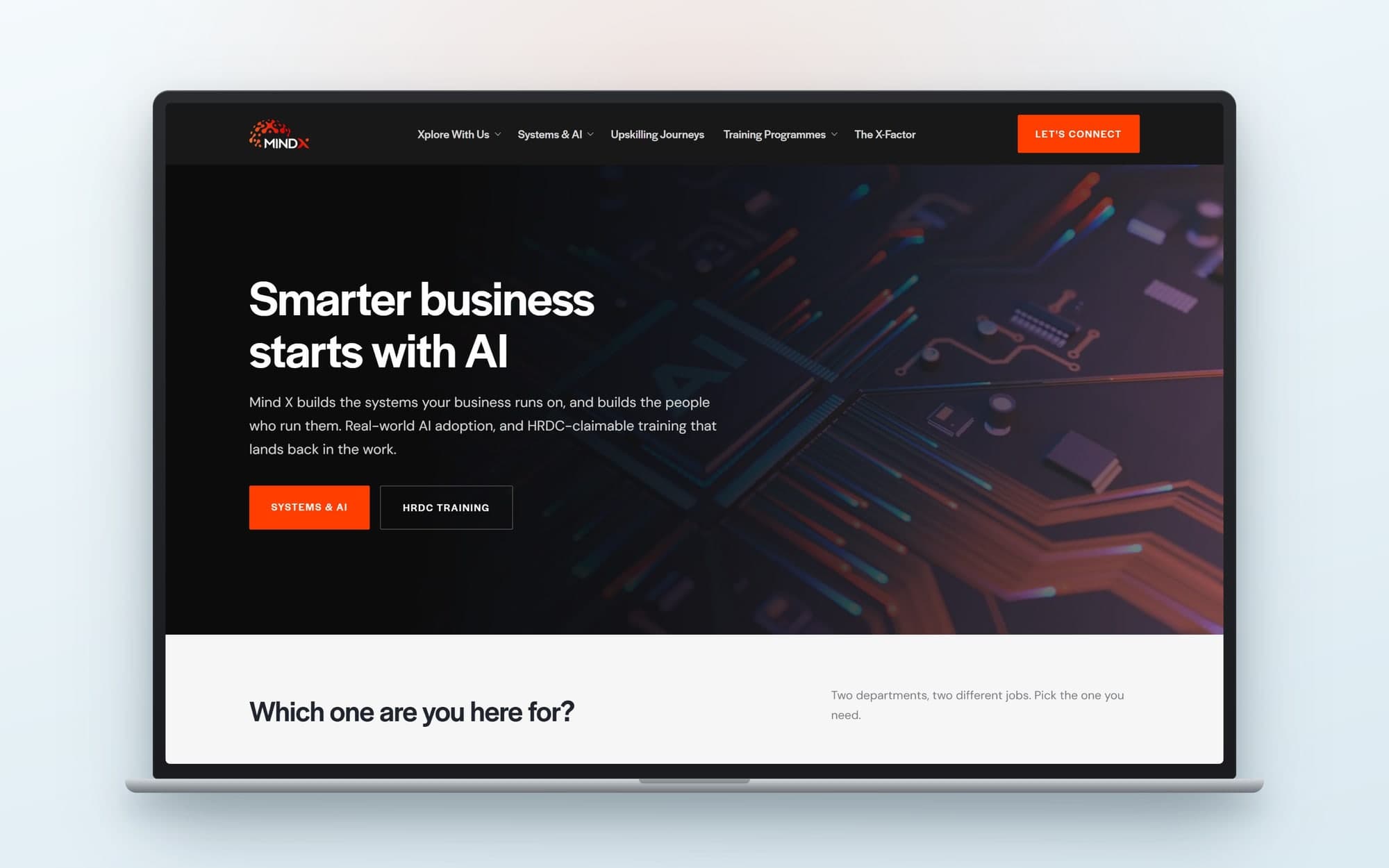
MindX: two businesses, one site
An AI systems and corporate training company in Kuala Lumpur. Twelve pages, designed and built from scratch.
View project